
Life After the Crimson: Redefining Identity Beyond the Harvard Label
Life after Harvard identity Graduation day at Harvard is a spectacle of joy, relief, and ambition.
Nevertheless, for many soon-to-be graduates, there is also an unspoken fear hiding beneath the crimson gowns.
In fact, this fear is not about failing to land a job or getting into a top grad school.
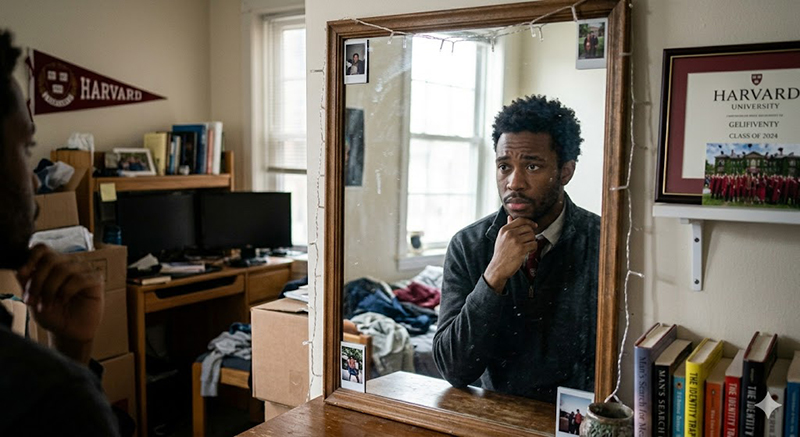
Instead, it runs much deeper: Who am I without the Harvard label?
For four years, you have been introduced as a Harvard student.
Consequently, that label has opened doors, silenced doubts, and shaped how others perceive you.
However, once you walk out of Widener Library for the last time as a student, that external identity begins to fade.
This article explores why this identity shift is so challenging.
Moreover, it offers practical ways to redefine yourself after Harvard — not around a brand, but around your own values and meaning.

1. Why the Harvard Label Becomes a Crutch
To understand the post-graduation identity crisis, we must first look at how the Harvard label functions during college.
First of all, the label provides instant social proof.
When you say “I study at Harvard,” people immediately assume you are intelligent, hardworking, and promising.
As a result, you rarely have to prove yourself in small, everyday settings.
In addition, the university environment constantly reinforces this identity.
Professors, classmates, and even family members treat you differently.
Consequently, you begin to internalize Harvard as part of your core self — not just a school you attend.
On the other hand, this can become dangerous after graduation.
Without the label, you may feel suddenly ordinary.
For instance, in a new workplace or city, no one will hand you automatic respect based on your diploma.
Thus, you face a painful question: If I am no longer a Harvard student, then who am I?
Furthermore, many Harvard graduates struggle with what psychologists call “role exit.”
This happens when you leave a powerful social role without having a new, equally strong role ready.
Therefore, the transition feels like a loss, not just a change.
2. Signs You Are Facing an Identity Shift
Not every Harvard graduate experiences this crisis openly.
Nevertheless, there are clear signs that the label has become too central to your self-worth.
To begin with, you might feel anxious when someone asks, “So, what do you do?”
Because your instinct is to say “I just graduated from Harvard,” but that answer has a short shelf life.
Similarly, you may catch yourself mentioning Harvard in conversations where it is not relevant.
This is not arrogance — it is a sign that you are unsure how to introduce yourself otherwise.
Another common sign is the fear of being ordinary.
After years of being told you are among the “best and brightest,” the idea of a quiet, unimpressive life can feel like failure.
As a result, you might chase prestigious jobs or degrees not because you want them, but because you need the next label.
In addition, you may notice that your self-esteem fluctuates wildly based on external achievements.
A good internship offer makes you feel worthy; a rejection makes you feel like a fraud.
This emotional rollercoaster indicates that your identity is still tied to performance and pedigree.
Finally, many graduates experience what I call “the reunion dread.”
You fear running into classmates one year after graduation because you might be seen as “the one who didn’t live up to the potential.”
Consequently, you compare your behind-the-scenes with everyone else’s highlight reel.
3. How to Redefine Your Identity After Harvard
The good news is that you can rebuild your identity — not around a brand, but around authentic meaning.
Nevertheless, this takes intentional effort.
Below are four practical strategies.
3.1 Run a Low-Visibility Experiment
First of all, try doing something meaningful where no one knows you are a Harvard graduate.
For example, volunteer at a local shelter, join a recreational sports league, or take a community class in a subject you know nothing about.
The goal is simple: experience being valued for your actions, not your pedigree.
Consequently, you will realize that your worth does not disappear when the label does.
In fact, this experiment often reduces the fear of being “just a normal person.”
3.2 Write Your Own “Post-Harvard Eulogy”
This exercise sounds strange, but it is highly effective.
Imagine someone who truly knows you is speaking at your 80th birthday.
What do you hope they say?
Notice that they will not list your diplomas or job titles.
Instead, they will mention your kindness, curiosity, humor, or resilience.
Therefore, this exercise reveals what actually matters to you.
Use that as your identity compass.
3.3 Create a “Non-Achievement Resume”
Most Harvard students have a resume full of awards, leadership roles, and test scores.
Nevertheless, that document only captures one dimension of life.
Take a blank page and list things that gave you joy or meaning without any external reward.
For instance:
-
“Learned to bake my grandmother’s bread recipe”
-
“Helped a friend through a difficult breakup”
-
“Ran three times a week without tracking pace”
As a result, you remind yourself that identity is not just accomplishments.
In fact, the non-achievement resume often feels more real than the formal one.
3.4 Allow a Two-Year “Moratorium”
You do not need to know who you are on graduation day.
In fact, putting pressure on yourself to have an answer immediately makes the anxiety worse.
Therefore, give yourself permission to explore for two years without calling it “wasted time.”
Try different jobs, cities, or hobbies.
Make mistakes. Change your mind.
After two years, you will not have a perfect answer — but you will have real data about what fits and what does not.
Consequently, your identity will be grounded in experience, not imagination.

4. A Quiet Conclusion: Ask a Better Question
Let me be honest with you.
I do not have a perfect answer to “Who am I after Harvard?”
In fact, I doubt anyone does on graduation day.
Nevertheless, I have learned that some questions are more useful than others.
Instead of asking “Who am I?” — which demands a fixed answer — try asking:
“What kind of person do I want to become, one small choice at a time?”
This question does not need a Harvard diploma.
It only needs a little courage, a little patience, and the willingness to be unknown for a while.
In conclusion, life after the Crimson is not about losing an identity.
It is about gaining the freedom to build one that is truly your own.
And that, perhaps, is the real graduation.