
Diploma vs. Degree: Navigating Your Educational and Career Path
Choosing between a diploma and degree represents a pivotal moment in any student’s journey. While both credentials validate your knowledge, they serve distinct purposes in the academic and professional worlds. Understanding these nuances is essential for aligning your education with your long-term career goals.
In this comprehensive guide, we will break down the structural differences, social roles, and employment utility of both options. Whether you are looking for a quick entry into the workforce or a deep academic foundation, this analysis will help you decide with confidence.
Defining the Basics: What Are They?
What is a Diploma?
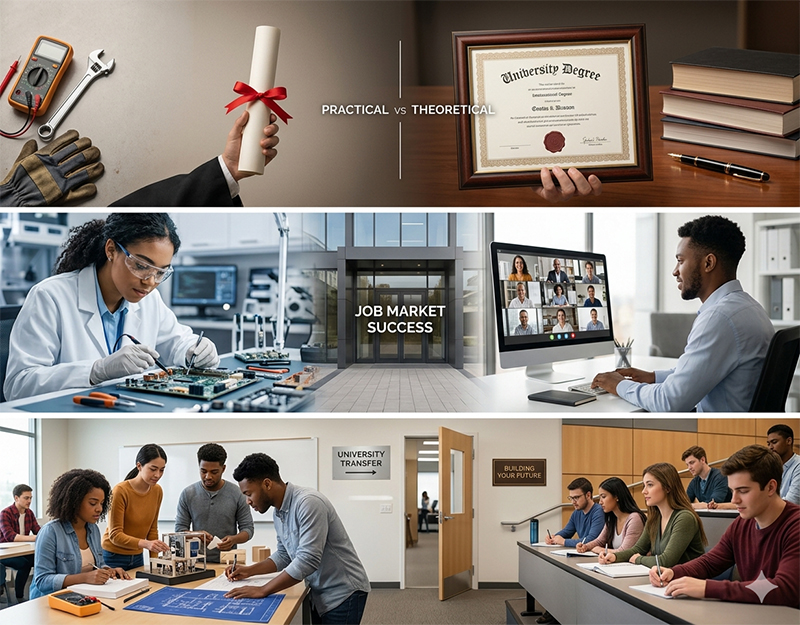
A diploma is generally a short-term program focused on specific technical or vocational skills. These programs prioritize practical training over theoretical exploration. Consequently, they are ideal for students who wish to master a particular trade, such as graphic design, nursing assistance, or automotive repair, in a relatively short timeframe.
What is a Degree?
Conversely, a degree is a more extensive academic program offered by colleges and universities. It encompasses a broad spectrum of subjects, including general education requirements like humanities and sciences, alongside a specialized major. Degrees—ranging from Associate and Bachelor’s to Master’s and Doctorates—aim to develop critical thinking, research skills, and a holistic understanding of a field.
Diploma and Degree: The Core Differences
To provide a clearer picture, let us examine how these two pathways diverge across several key metrics.
| Feature | Diploma | Degree |
| Duration | 1 to 2 years | 3 to 4 years (Bachelor’s) |
| Focus | Practical & Vocational | Theoretical & Comprehensive |
| Cost | Generally lower | Generally higher |
| Institution | Community colleges, trade schools | Universities, 4-year colleges |
| Curriculum | Specialized subjects only | Major subjects + General education |
| Flexibility | Often fixed schedules | Higher elective flexibility |
The Social Role of Qualifications
Beyond personal gain, both diplomas and degrees play significant roles in the fabric of society. They act as signals to the community about an individual’s persistence and specialized capabilities.
Social Mobility and Equity
Historically, a degree has been viewed as the ultimate engine for social mobility. It often provides access to high-status professions and networking circles that might otherwise remain closed. However, diplomas are increasingly recognized for their role in economic equity. By providing affordable, specialized training, diplomas allow individuals from diverse backgrounds to enter essential industries quickly.
Community Contribution
Diplomas often fill immediate gaps in the local labor market. For instance, a surge in medical diplomas directly supports the healthcare infrastructure of a growing city. Meanwhile, degrees foster a culture of research and innovation. University graduates often lead the way in scientific breakthroughs and social policy changes that benefit the collective.
Utility in the Modern Job Market
When it’s time to find a job, the “diploma vs. degree” debate becomes even more practical. Your choice will largely depend on the industry you wish to enter.
When a Diploma Wins
If you are entering a field that values hands-on proficiency above all else, a diploma is often the superior choice. Employers in sectors like coding, specialized manufacturing, or culinary arts often care more about what you can do than what you have read. Furthermore, because diploma programs are shorter, you can enter the workforce sooner, potentially earning a salary while degree-seeking peers are still in the classroom.
When a Degree is Essential
In contrast, many regulated professions—such as law, medicine, engineering, and high-level finance—strictly require a degree. A degree serves as a “barrier to entry” for corporate leadership roles. Furthermore, statistics consistently show that degree holders often command higher lifetime earnings and face lower unemployment rates during economic downturns.
Bridging the Gap: The Hybrid Approach
It is important to note that these two paths are not mutually exclusive. Many successful professionals start with a diploma to gain immediate employment and later “ladder” those credits into a full degree. This modular approach to education is becoming a favorite for those who need to balance financial stability with academic ambition.
Frequently Asked Questions (FAQ)
1. Is a diploma better than a degree?
Neither is inherently “better.” A diploma is better for quick, practical entry into technical fields, while a degree is better for long-term career versatility and high-level professional accreditation.
2. Can I get a high-paying job with only a diploma?
Yes. Many specialized trades, such as air traffic control, web development, or dental hygiene, offer competitive salaries to diploma holders.
3. Will my diploma credits count toward a degree later?
Often, yes. Many universities have “articulation agreements” with colleges that allow you to transfer diploma credits toward a Bachelor’s degree, saving you time and money.
4. Why do employers prefer degrees for management roles?
Degrees typically include coursework in communication, ethics, and critical thinking. Employers often view these “soft skills” as essential for leadership and complex decision-making.
Conclusion: Making Your Decision
In summary, the choice between a diploma and degree hinges on your personal timeline, budget, and career aspirations. If you are eager to master a specific craft and start working within a year or two, a diploma is an excellent investment. However, if you seek a broad academic foundation and aim for professions that require formal licensure, a degree remains the gold standard.
Regardless of the path you choose, the most important factor is a commitment to lifelong learning. In today’s rapidly evolving economy, your ability to adapt and acquire new skills—whether through a classroom or on the job—will be your greatest asset.